Gone by Sunday: Why Nothing Lasts Anymore — On Purpose
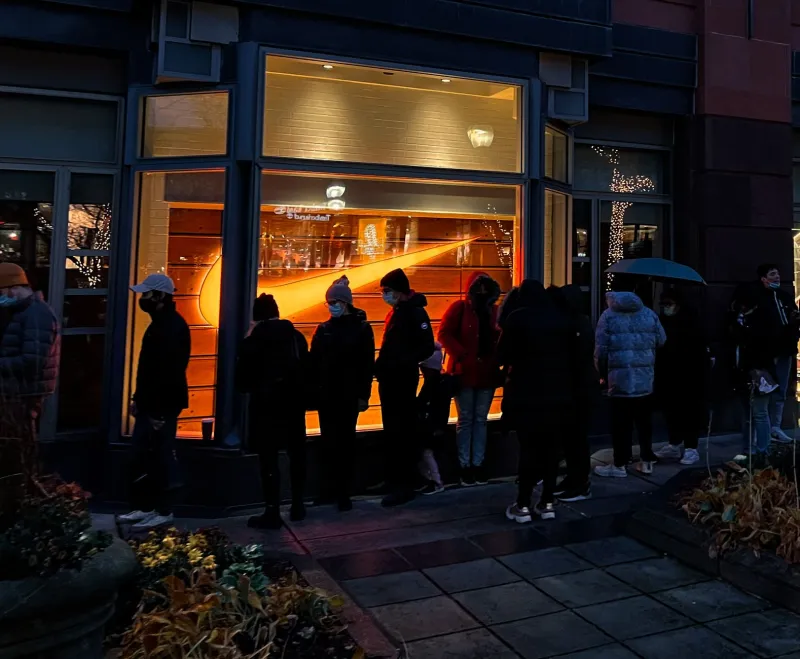
There's a vintage shop in Brooklyn that exists for exactly one weekend. Not 'closing soon' — gone. The racks arrive Thursday, the line wraps around the corner by Saturday noon, and by Sunday night there's a broom and an empty storefront and a QR code on the window for the next drop, in a different neighborhood, three months from now.
This is not a fringe experiment. This is, increasingly, how cool works in America. The pop-up — the temporary café takeover, the two-night supper club, the 'limited to 200 guests' anything — has stopped being a stepping stone toward a real business and become the real business. Permanence is out. The countdown clock is in.
Scarity Sells, and Everybody Knows It Now
Let's not pretend this is mysterious. Scarcity has always moved product. But the pop-up boom has turned a sales tactic into a cultural default, and the mechanism is pure FOMO economics.
A permanent store gives you the option to visit. A pop-up gives you a deadline. And deadlines convert. The knowledge that something disappears — this weekend, this month, this drop — collapses the 'I'll get to it' that kills so many small businesses. You either show up or you miss it, and missing it has become its own social cost. 'You went to the ___ pop-up?' is the new 'you saw that show?'
The numbers back the vibes. Limited releases routinely outperform evergreen inventory. Reservation-based supper clubs sell out in minutes. Brands that once measured success in square footage now measure it in waitlist length.
Why Founders Stopped Wanting Leases
But it's not just consumer psychology — the supply side has its own reasons, and they're mostly about risk.
Commercial rents in the places where cool concentrates are brutal. A five-year lease is a bet that your taste, your neighborhood, and the economy will all hold still, and nothing holds still anymore. A one-month residency in a landlord's vacant storefront? That's a different math entirely: low overhead, low commitment, and — crucially — a built-in marketing story. 'We're only here for three weeks' does the advertising for free.
There's also a labor-of-love recalibration happening. A generation of makers watched restaurants and retail shops grind owners into dust and decided they wanted the fun part — the launch, the buzz, the full room — without the decade of entropy that follows. The pop-up lets you be a founder in weekends instead of years.
And for landlords? A rotating cast of temporary tenants keeps a vacant space alive, generates foot traffic for the block, and costs less than a 'for lease' sign. Everyone's incentives point the same direction: toward temporary.
The Countdown Is the Content
Here's the part that makes the pop-up uniquely suited to this moment: it generates its own media. A permanent store is a place. A pop-up is an event — and events are what the internet runs on.
Every pop-up arrives with a clock, and a clock is a story: the line, the 'day one' hauls, the 'did you make it before they closed' group texts. The temporary format hands creators and attendees a reason to post, and the posts hand the next city a reason to care. By the time the thing closes, its afterlife on social media may be worth more than its actual sales.
Compare that to a permanent shop, which gets one opening-day story and then settles into being infrastructure. Nobody's filming their third visit to a store that's always there.
The Commitment Question
Which brings us to the uncomfortable part. The pop-up boom is fun, but it's also a symptom. We've imported the logic of the story — here for 24 hours, then it vanishes — into the physical world, and we should at least ask what we lose.
Third places used to earn their meaning through repetition. The café where the barista knows your order becomes yours because it persists. A city is a stack of places that stayed. If the default format for new spaces is 'gone by Sunday,' we risk a landscape that's all premieres and no reruns — endlessly exciting, weirdly rootless.
There's also a quiet inequity in FOMO economics. Scarcity rewards people with flexible schedules, fast thumbs, and insider knowledge. The 'limited to 200 guests' model isn't just marketing; it's a velvet rope, and velvet ropes are never neutral.
And yet — the counterargument is fair too. Maybe refusing to commit isn't flakiness. Maybe it's honesty. A pop-up that promises one weekend and delivers one weekend never breaks a promise. It's the five-year lease with a three-month lifespan that leaves the empty storefronts behind.
Enjoy It While It's Literally There
The pop-up isn't a phase, and it's not going to grow up into permanence. It's the format now — a culture that treats presence as premium and duration as overhead. The smartest operators in the country are currently betting that you'll care more about something precisely because you can't have it for long.
They're probably right. So the next time you see a line around a storefront that didn't exist last month, get in it. Whatever's inside will be magic, briefly.
And then it'll be gone — on purpose, and right on schedule.